
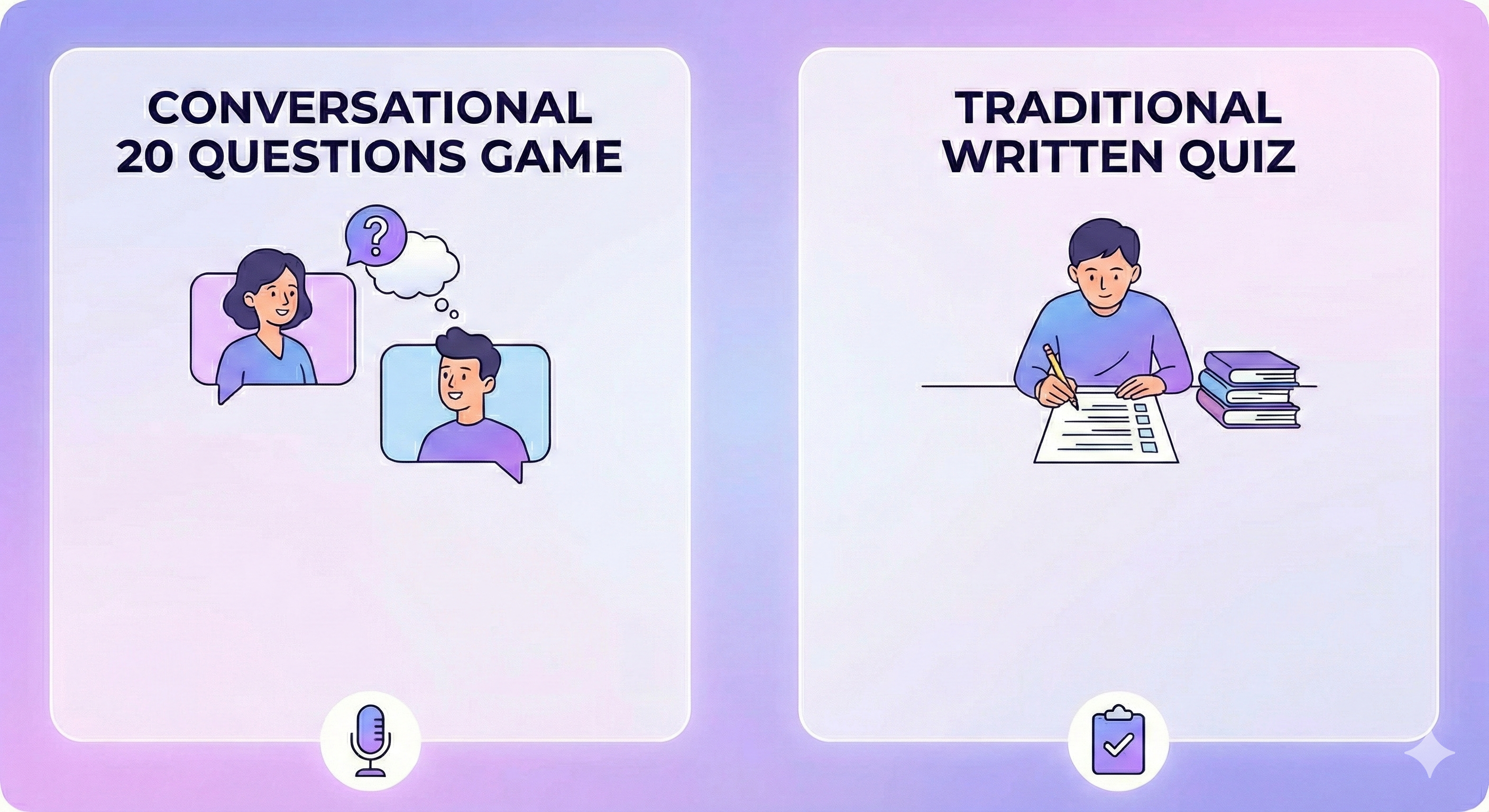
Is 20 Questions a Quiz? Understanding the Difference and Using Both Effectively
When planning engaging classroom activities, teachers often reach for familiar formats. The game of 20 questions has obvious appeal, but is 20 questions a quiz in the traditional sense? Understanding the distinction helps you deploy each format for maximum educational impact.
Defining Our Terms
A quiz, in classroom terms, typically involves a set of predetermined questions with specific correct answers. The teacher knows what they're asking before the quiz begins, and students are assessed on their ability to provide accurate responses.
20 questions works differently. The questions emerge organically from students attempting to discover an unknown answer. There's no script, no predetermined path, and the 'correct' response to each question is simply yes or no.
Where They Overlap
Despite structural differences, both formats share educational objectives:
Knowledge Application Whether answering quiz questions or formulating strategic questions in 20 questions, students must draw on existing knowledge. You can't ask "Is it a mammal?" without understanding what mammals are.
Engagement Through Challenge Both formats create productive struggle. Quizzes challenge students to recall and apply information; 20 questions challenges them to think systematically and deduce logically.
Immediate Feedback Students discover quickly whether their quiz answer was correct or whether their yes/no question brought them closer to the solution. This rapid feedback loop accelerates learning.
Where They Differ
Student Agency In a quiz, students respond to teacher-selected questions. In 20 questions, students drive the inquiry. This shift in agency changes the cognitive demands entirely.
Assessment Clarity Quizzes produce clear, measurable outcomes. 20 questions reveals thinking processes but doesn't generate traditional marks. Both have value; they simply measure different things.
Preparation Requirements Quizzes require question preparation. 20 questions requires only that the teacher (or leading student) thinks of an appropriate subject. Spontaneous classroom moments favour 20 questions; structured revision favours quizzes.
How to Play 20 Questions in a Classroom
For teachers new to the format:
- Choose an appropriate subject connected to recent learning
- Establish the category to scaffold younger students
- Model effective questioning before students lead
- Track questions visually so students see progress
- Discuss strategy after each round
The real learning often happens in the post-game discussion. Why did certain questions eliminate more possibilities than others? What would you ask differently next time?
Combining Both Formats
The most effective classrooms don't choose between quizzes and 20 questions; they use both strategically.
Start a lesson with 20 questions to activate prior knowledge. The format warms up thinking without the pressure of assessment. Students who might freeze on a quiz question happily contribute yes/no questions to a group effort.
Transition to a structured quiz for consolidation. Now that relevant knowledge is active, formal questions feel less daunting. The contrast in formats maintains engagement across the lesson.
Close with student-led 20 questions as a reward. Give quiz winners the privilege of thinking of the subject, creating positive associations with quiz performance.
Digital Enhancement
Traditional 20 questions requires nothing but imagination, but quizzes benefit enormously from technology. Paper-based quizzes create logistical headaches: distribution, collection, marking, feedback delays.
Platforms like Pondera transform the quiz portion of this combined approach. Every student answers simultaneously, results appear instantly, and the competitive element that makes 20 questions exciting transfers to structured quiz content. You keep the organic inquiry of 20 questions for activation and discussion, whilst deploying proper quiz technology for assessment and consolidation.
Making the Right Choice
Choose 20 questions when you want to:
- Activate prior knowledge
- Develop questioning skills
- Create collaborative thinking
- Fill unexpected time gaps
Choose quizzes when you want to:
- Assess specific knowledge
- Provide structured revision
- Generate measurable outcomes
- Ensure every student engages individually
The Best of Both Worlds
Understanding the distinction between 20 questions and quizzes lets you deploy each format for its strengths. They complement rather than compete with each other in a well-designed learning experience.
Ready to elevate your quiz delivery? Pondera handles the assessment side brilliantly, leaving you free to use 20 questions for those valuable discussion moments that no technology can replace.