
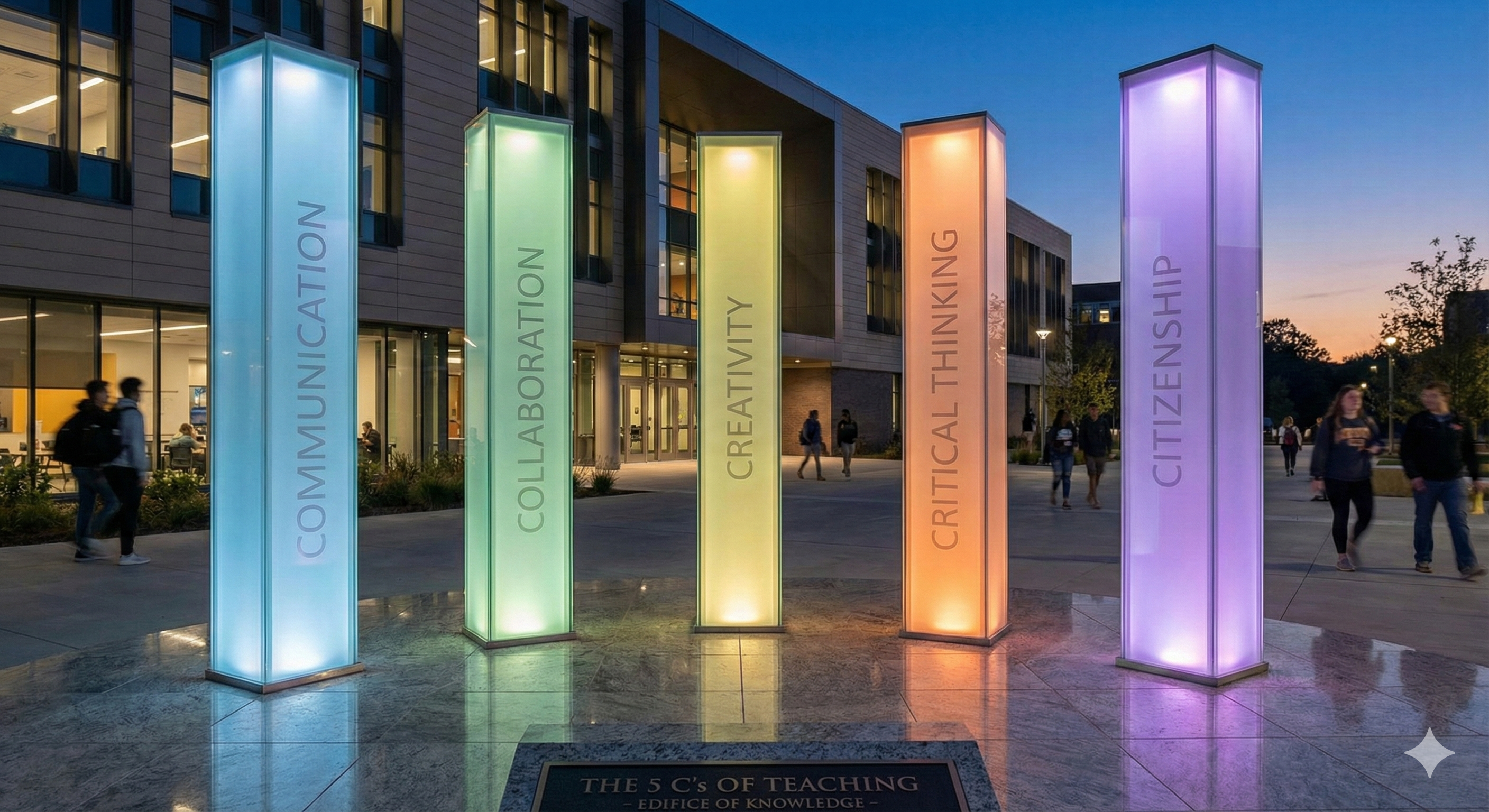
What Are the 5 C's of Teaching? Building Essential Skills in Every Lesson
Educational frameworks help teachers design learning experiences that develop well-rounded students. The 5 C's of teaching provide a lens for planning lessons, asking questions, and assessing progress. Understanding what the 5 C's are and how to apply them transforms good teaching into great teaching.
The 5 C's Explained
Critical Thinking
The ability to analyse, evaluate, and form reasoned judgements. Critical thinkers don't accept information passively; they question sources, examine evidence, and consider alternatives.
In practice, this means asking students to:
- Evaluate the reliability of sources
- Identify strengths and weaknesses in arguments
- Compare different viewpoints
- Draw conclusions from evidence
- Question assumptions
Creativity
The capacity to generate novel ideas, approaches, and solutions. Creativity extends beyond art into every subject; scientists need creativity to design experiments, mathematicians need it to approach problems from new angles.
In practice, this means:
- Offering open-ended challenges
- Accepting multiple valid approaches
- Encouraging risk-taking without penalty
- Connecting disparate concepts
- Valuing originality alongside accuracy
Collaboration
The skill of working effectively with others. Modern workplaces rarely feature isolated individual work; collaboration matters professionally and personally.
In practice, this means:
- Structuring group work purposefully
- Teaching explicit collaboration skills
- Holding individuals accountable within groups
- Varying group compositions
- Reflecting on teamwork effectiveness
Communication
The ability to convey ideas clearly across contexts and audiences. Communication encompasses writing, speaking, visual presentation, and digital literacy.
In practice, this means:
- Providing varied communication opportunities
- Teaching audience awareness
- Offering feedback on clarity
- Developing listening alongside speaking
- Including formal and informal communication practice
Character
The development of personal qualities that enable effective citizenship and ethical behaviour. Character encompasses resilience, integrity, empathy, and responsibility.
In practice, this means:
- Modelling desired behaviours
- Discussing ethical dimensions of content
- Building classroom community
- Recognising and reinforcing positive character
- Connecting learning to real-world impact
Integrating the 5 C's into Daily Teaching
Rather than teaching the 5 C's as separate units, weave them into regular practice:
Lesson Starters Begin with a question requiring critical thinking about yesterday's content, or a creative challenge connecting to today's topic.
Main Activities Structure learning to include collaborative elements where communication matters for success.
Assessment Design tasks that require multiple C's simultaneously. A group presentation demands collaboration, communication, and critical thinking at minimum.
Reflection End lessons by connecting learning to character development. How does today's understanding help us act responsibly?
The 5 C's and Classroom Quizzes
Each of the 5 C's can feature in quiz design:
Critical Thinking Quizzes Include questions requiring analysis rather than recall. "Which of these sources would be most reliable for research on climate change, and why?"
Creativity Quizzes Open-ended questions inviting novel responses. Scoring creativity requires rubrics, but the thinking matters.
Collaboration Quizzes Team quiz formats where groups compete. Students must communicate effectively to succeed.
Communication Quizzes Questions requiring clear explanation. Short answer questions asking students to explain concepts reveal communication ability.
Character Quizzes Questions with ethical dimensions. "What should the character do in this situation?" connects content to values.
What Are Good Questions to Ask a Classroom?
Filtering questions through the 5 C's ensures variety:
For Critical Thinking:
- What evidence supports this conclusion?
- What are the weaknesses in this argument?
- How might this claim be tested?
For Creativity:
- What other approaches could solve this problem?
- How might this look from a different perspective?
- What connections can you make to other subjects?
For Collaboration:
- What did your group discuss before deciding?
- How did you reach agreement when views differed?
- What role did each person play?
For Communication:
- How would you explain this to a younger student?
- What's the most important point to convey?
- How might you present this visually?
For Character:
- What's the right thing to do here?
- How does this connect to your responsibilities?
- What impact might this have on others?
Moving Beyond Framework Understanding
Knowing the 5 C's theoretically matters less than applying them practically. Consider:
Planning: Which C's does this lesson develop? Delivery: Am I providing opportunities for all 5 C's across the week? Assessment: Do my quizzes and assessments touch multiple C's? Reflection: Which C's need more attention in my teaching?
Interactive Quizzes and the 5 C's
Traditional quizzes often focus narrowly on critical thinking through recall and analysis. Interactive quiz platforms expand possibilities.
Pondera's team-based options naturally incorporate collaboration. The competitive format develops character through graceful winning and losing. Communication happens when students explain choices to teammates. Creativity emerges in question design and student responses to open formats.
The live, engaging format means students experience the 5 C's in action rather than just answering questions about them.
Building a 5 C's Classroom
The 5 C's provide a compass for teaching decisions. When planning lessons, asking questions, designing assessments, or reflecting on practice, filter through these five lenses.
Students who develop critical thinking, creativity, collaboration, communication, and character leave school equipped for futures we cannot fully predict.
Ready to bring the 5 C's to your quiz practice? Pondera creates quiz experiences that engage multiple skills simultaneously, making assessment a development opportunity rather than mere measurement.