
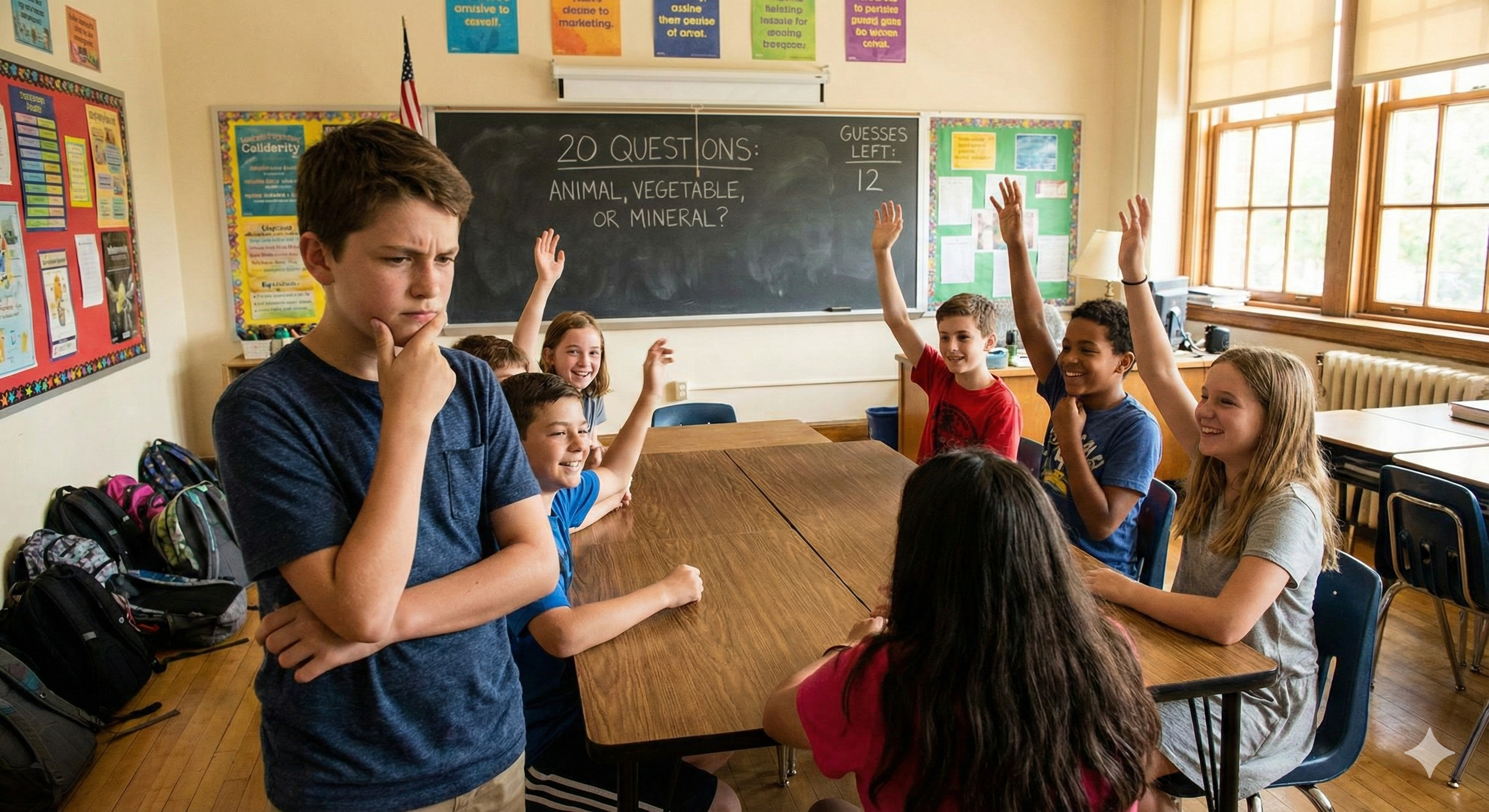
Who Do You Play 20 Questions With? Classroom Configurations That Work
The game of 20 questions adapts remarkably well to different group sizes and classroom dynamics. Understanding who do you play 20 questions with, and how different configurations change the learning experience, helps you deploy this classic game for maximum educational impact.
The Classic Format: One vs Many
In the traditional setup, one person thinks of something while everyone else collaborates to guess it. In classroom terms, this typically means the teacher holds the answer while students ask questions.
This configuration offers several advantages:
Quality Control You can ensure the subject connects to recent learning, maintains appropriate difficulty, and provides genuine educational value.
Modelling Opportunities When students ask poorly constructed questions, you can guide them toward better approaches without embarrassing anyone who held the secret.
Pacing Control You determine when to give hints, when to redirect thinking, and when to reveal the answer. The game stays productive.
The limitation is passive waiting. Between questions, most students are simply listening rather than actively participating.
Student vs Class
Shifting the 'answerer' role to a student changes everything. Now you're free to observe questioning quality, manage participation, and assess understanding from the outside.
This works best when:
- Students understand the game format from previous teacher-led rounds
- The subject category is clearly defined
- There's a mechanism for fair question distribution
Consider having the student answerer choose the next questioner, ensuring variety. Alternatively, use a random name generator for truly equitable participation.
Small Group Competitions
Divide the class into groups, each playing simultaneously with their own secret subject. This configuration maximises active participation since everyone is either asking or answering at any moment.
Group size matters significantly:
Pairs One-to-one play develops individual questioning skills intensively. Students cannot hide behind more confident peers. However, it lacks the collaborative discussion that generates deeper thinking.
Groups of 3-4 This sweet spot allows discussion before each question whilst maintaining pace. Students naturally debate which question to ask next, developing reasoning skills through peer interaction.
Groups of 5+ Larger groups risk disengagement. Quieter students can avoid participation entirely, and the question rate slows considerably.
Whole Class Collaborative
Rather than competing, the entire class works as a single unit against a challenging subject or a tight question limit. This collaborative approach suits:
- Classes with competitive tensions that might become problematic
- Complex curriculum subjects requiring pooled knowledge
- Building classroom community and shared achievement
The energy differs from competitive play. Success belongs to everyone, and stronger students naturally support weaker ones to achieve the collective goal.
Teacher vs Students
Reverse the traditional format entirely. Students think of something, and you have 20 questions to guess. This reveals:
- What students consider important or memorable from lessons
- How well students understand categorisation and subject boundaries
- Whether students can maintain focus on a single concept
It's also remarkably humbling. Students delight in genuinely stumping their teacher, and failing gracefully models that not knowing answers is acceptable.
Mixed Ability Considerations
Who plays with whom matters enormously in mixed-ability classrooms.
Strategic Grouping Place stronger questioners across different groups rather than clustering them. This distributes modelling naturally.
Tiered Subjects Lower-ability groups receive narrower categories or more concrete subjects. Higher-ability groups tackle abstract concepts or broader fields.
Role Rotation Ensure the 'answerer' role rotates through abilities. Every student should experience holding the secret, not just the most confident.
Digital Extension: From 20 Questions to Interactive Quizzes
20 questions develops questioning skills beautifully, but it's inherently difficult to assess formally. The game produces rich discussion but limited measurable outcomes.
Transitioning from 20 questions to structured quizzes captures the engagement whilst adding assessment value. Pondera bridges this gap elegantly. After a warm-up round of 20 questions to activate thinking and discussion, move into a Pondera quiz where every student answers simultaneously. You maintain the competitive energy whilst gaining clear data on understanding.
Choosing Your Configuration
For developing questioning skills: Teacher holds the secret, whole class asks For maximum participation: Small groups of 3-4 playing simultaneously For assessment of student understanding: Students hold secrets, reveal their reasoning For building community: Whole class collaborative against challenging subjects For reward and entertainment: Students vs teacher, trying to stump you
Make the Transition Seamless
20 questions activates thinking; quizzes consolidate learning. Pondera makes that transition smooth, keeping energy high whilst ensuring every student demonstrates understanding. The games complement each other beautifully in a well-structured lesson.